
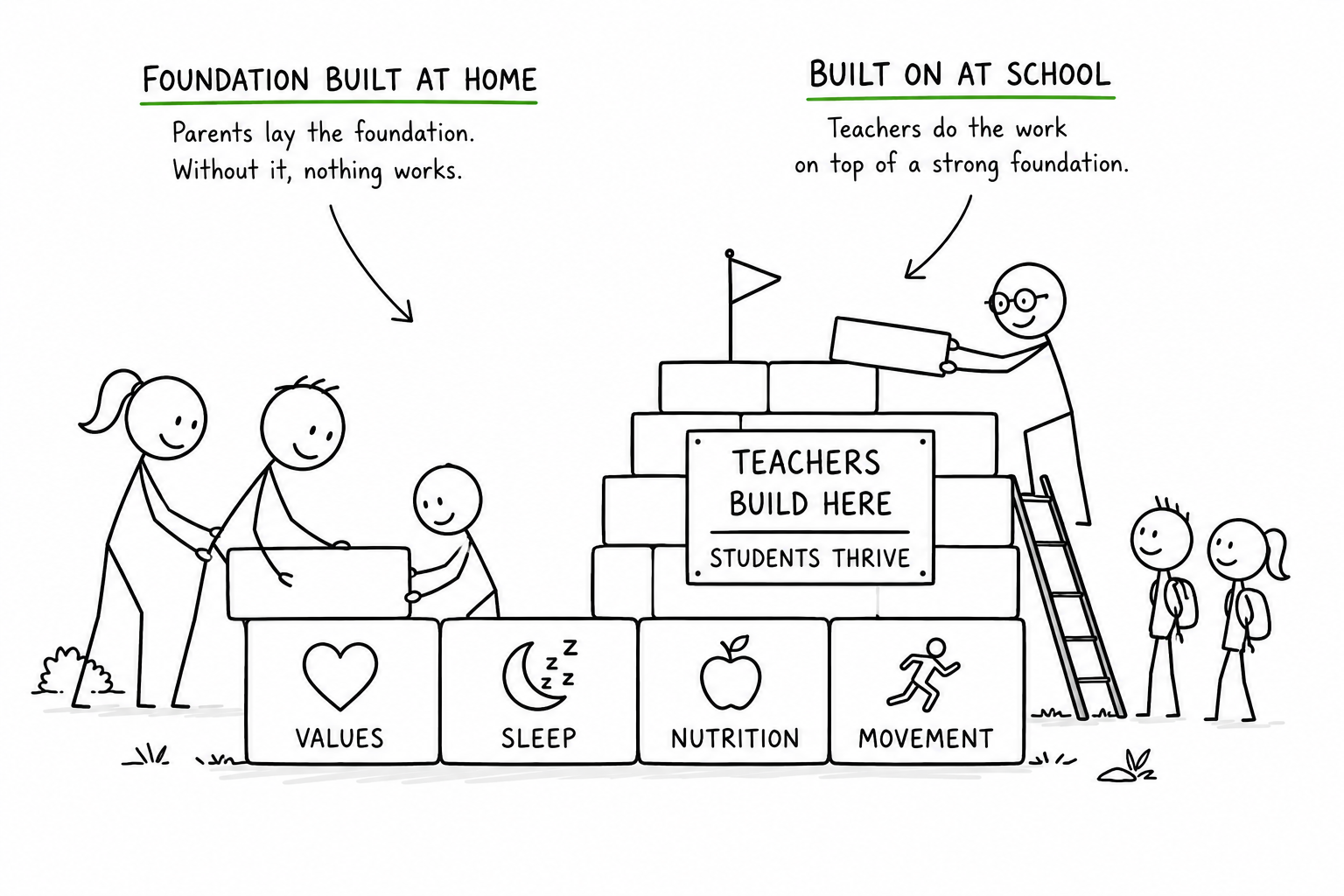
Teachers can do extraordinary work—but they cannot replace the foundations children need before learning can happen.
When a child struggles at school, we naturally look toward the school.
Is the teacher good enough?
Is the teaching engaging enough?
Does the student get enough support?
Are the learning materials good enough?
Should the school be doing more?
These are legitimate questions.
But there is another question that can be much more uncomfortable:
What is the responsibility of the parent?
Parents should not be expected to teach mathematics.
They should not need to understand chemistry well enough to explain chemical equilibrium.
They should not have to become experts in pedagogy, learning analytics or AI tutoring systems.
That is not their job.
But education does not begin when a child walks through the school doors.
Long before a teacher can teach anything, there is a foundation being built at home.
And some parts of that foundation cannot be outsourced to a school.
1. Build the Moral Foundation First
Before mathematics, there is morality.
Before academic achievement, there is character.
Before asking whether a child knows the correct answer, we should probably ask what kind of person we are helping that child become.
Honesty.
Responsibility.
Respect.
Empathy.
Fairness.
Keeping your word.
Accepting consequences.
Understanding that other people matter.
Knowing the difference between what you can do and what you should do.
These are not simply school subjects.
They are part of the environment in which a child grows up.
A school can reinforce them.
A teacher can model them.
Society can encourage them.
But the foundation is largely built through thousands of small interactions at home.
What happens when you make a mistake?
What happens when someone weaker than you needs help?
What happens when nobody is watching?
What happens when telling the truth has consequences?
What happens when you disagree with someone?
Children learn the answers to these questions partly from what adults tell them.
But perhaps even more importantly, they learn them by watching what adults do.
Education without ethics can produce knowledgeable people.
It does not necessarily produce good ones.
And in an age where AI gives individuals increasingly powerful capabilities, that distinction may become more important, not less.
2. Make Sure They Sleep
Then we get to something much less philosophical.
Sleep.
We can build incredible schools.
We can develop personalized AI tutors.
We can optimize learning materials.
We can train excellent teachers.
But none of that changes a basic biological reality:
A chronically exhausted brain is a terrible place to try to put an education.
Children and teenagers need sufficient sleep.
That means parents have some responsibility for creating an environment where sufficient sleep is actually possible.
Not merely saying:
“You should go to bed earlier.”
But thinking about routines.
Phones.
Gaming.
Social media.
Late-night distractions.
Morning schedules.
Caffeine.
The environment in which sleep happens.
There will obviously come an age when parents cannot control exactly when their child falls asleep.
But there is a big difference between controlling sleep and taking responsibility for the conditions surrounding it.
If a student arrives at school exhausted every morning, we cannot expect a teacher to magically compensate for that.
Sometimes the learning problem starts several hours before the school day begins.
3. Feed the Brain You Expect to Learn
The same applies to nutrition.
Learning is a cognitive activity.
But cognition happens inside a biological organism.
A student who has not eaten properly does not leave their body outside the classroom and send only their brain inside.
Hunger comes with them.
Energy levels come with them.
Hydration comes with them.
The consequences of poor routines come with them.
Parents do not need to create a scientifically optimized performance diet.
Children do not need to eat like professional athletes.
But ensuring reasonably nutritious food and regular meals is part of creating the physical foundation for learning.
Again, this sounds almost too obvious to mention.
Perhaps that is exactly why it deserves mentioning.
We often discuss education as though learning were primarily an information problem.
Give students better information.
Better explanations.
Better exercises.
Better technology.
Better teachers.
But before any of that matters, the student needs a body capable of showing up and doing the work.
4. Make Movement Part of Education
And that brings us to exercise.
Children need to move.
Not because every child needs to become athletic.
Not because everyone needs to play competitive sports.
And certainly not because physical fitness determines someone's value.
But because the brain is attached to a body.
Walking.
Running.
Cycling.
Swimming.
Playing outside.
Team sports.
Gym training.
Hiking.
Dancing.
Whatever gets the body moving.
Physical activity should not be viewed merely as something that happens instead of learning.
It is part of creating a human being capable of learning.
And perhaps we should think about exercise more broadly than physical exercise.
The mind needs exercise too.
Reading something difficult.
Solving problems.
Building things.
Playing strategy games.
Having conversations.
Being bored long enough to invent something to do.
Trying something without immediately asking for the answer.
Concentrating without constantly switching between stimuli.
These are forms of training.
Not every moment of childhood needs to be easy, entertaining or optimized.
Some struggle is useful.
Some boredom is useful.
Some frustration is useful.
Because eventually education requires the ability to stay with something that does not immediately reward you.
Parents Do Not Need to Become Teachers
None of this means parents should stand over their children every evening checking homework.
It does not mean parents should become substitute teachers.
And it certainly does not mean every academic difficulty should be blamed on the home.
Children have different abilities.
Families have different circumstances.
Schools have enormous responsibilities of their own.
Teachers matter.
Learning support matters.
Good educational technology matters.
But dividing responsibility does not require pretending that responsibility belongs entirely to one side.
Perhaps the division should look something like this:
Parents build the foundation.
Schools build on it.
Teachers guide the learning.
Students gradually learn to take responsibility for themselves.
And technology should support all of them.
The Goal Is Independence
There is an important final step.
A parent's responsibility cannot be to manage these things forever.
The goal is not to produce a 25-year-old whose parents still tell them when to sleep, what to eat and when to study.
The goal is transfer.
At first:
“Go to bed.”
Eventually:
“I know I perform badly when I don't sleep enough.”
At first:
“Eat something before school.”
Eventually:
“I need to take care of my body if I expect my brain to perform.”
At first:
“Put the phone away and finish this.”
Eventually:
“I need to manage my attention.”
At first, morality is taught.
Eventually, it becomes character.
That may be one of the most important responsibilities parents have in education:
Not doing education for their children, but gradually helping their children become capable of taking responsibility for their own lives.
Because the ultimate goal of education is not a child who always has someone making good decisions for them.
It is an adult who can make those decisions when nobody else is there.